


With the 2025 releases wrapped up, it’s time to talk about what we have lined up next for our ultimate multi-material platform, the Prusa XL! It’s still the largest, fastest and most capable toolchanger you can get. To make it even better, we plan on expanding the XL further with brand-new toolheads in 2026. As a cherry on top, you can now get it for the lowest price ever.
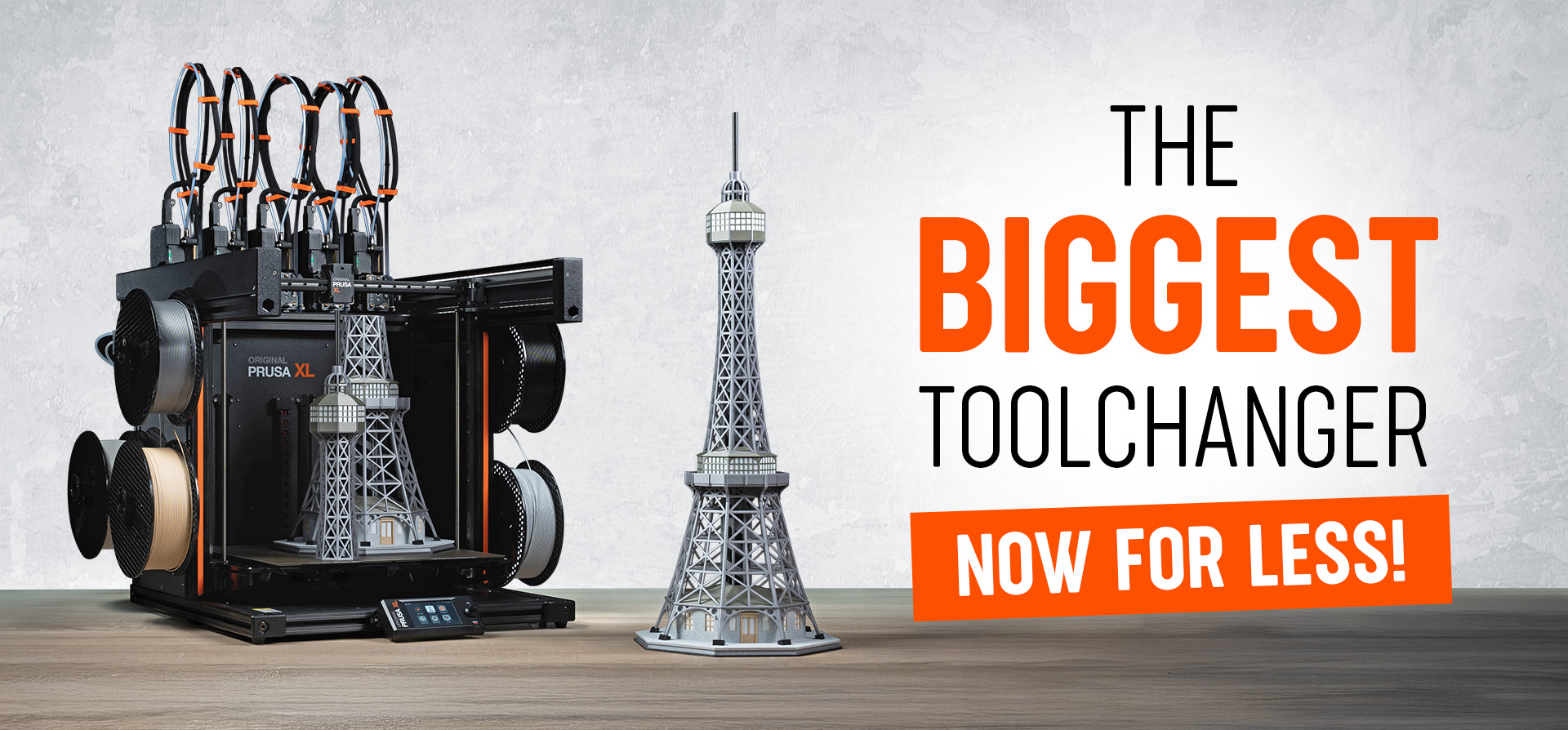
However, you’re probably also interested in where the XL’s heading now and what sets it apart from the recently introduced multi-material INDX upgrade for the CORE One+ and CORE One L printers. So, let’s start with that.
XL vs INDX
Both the XL and INDX are toolchanging systems, but they’re built on fundamentally different principles. Understanding this helps you figure out which approach fits your needs.
Active and Passive Toolchanger
The XL is an active toolchanger. Each of its toolheads is a complete, self-contained print head with its own hotend and nozzle. When switching materials, a mechanical arm picks up the entire toolhead, prints with it, then docks it and grabs the next one. Toolheads can stay heated and ready for quick switches, and automatically power off when they won’t be needed for a while.

INDX, on the other hand, is a passive toolchanger. It uses a single active print head that switches between passive tools, each loaded with a filament and equipped with a nozzle. The print head picks a tool, heats its nozzle, prints, docks it, and repeats the process with the next tool when a material change is needed.

We love the INDX upgrade for its low mass, cost efficiency, and support for up to eight materials. The XL, on the other hand, keeps every nozzle heated and ready to go, which makes material changes faster. The ability to mix different nozzle sizes, materials, and even non-FDM toolheads across five slots gives it real flexibility for complex engineering applications.
And then there’s the sheer build volume. At 360×360×360 mm, the XL offers over 3× the volume of the CORE One+ and still 50% more than the CORE One L. That’s a difference that turns multi-part assembly into a single overnight print.

What about speed?
When comparing different filament changing systems, no doubt the first question that comes to mind is toolchange time. It’s what everyone focuses on first. We’ve intentionally avoided publishing a single headline number, because toolchanges are tricky to measure fairly.
The difference in toolchange time between INDX and XL mainly occurs due to the different heating strategies. Each XL toolhead has its own heating element that keeps the nozzle very close to the target temperature. In most cases, it’s able to heat it to 100% during the toolchange itself. INDX, on the other hand, docks a nozzle, and heats up the following one from scratch. The print head uses induction, so the nozzle heating is super fast, but still slower than pre-heated nozzles on the XL. For this reason, when it comes to pure toolchange speed, the XL will likely stay ahead.
But a single number like that doesn’t say much about how efficiently a printer handles real-world prints day to day.
A fully-fledged Toolchanger has one more extra large advantage. You can completely exchange some (or all!) of the toolheads for something even more exciting than FDM printing.
Platform Ready for Growth
Just like our other printers, we’ve designed the XL to grow. And grow it did! It quickly became the go-to multimaterial platform, supported by countless community upgrades and tweaks. But still, while most of them tweak various parts of the printer, they mostly leave the tool heads as they are.
We want to show you what becomes possible once you start swapping entire XL toolheads. That’s the magic of having a fully-equipped and open Toolchanger system only the XL offers. It pushes well beyond a simple FDM system that mixes melted plastic.
Accessible Silicone Printing
One of the most significant additions announced in 2025 is a plug-and-play, non-FDM toolhead that enables the XL to print liquid materials such as heat-resistant silicone! We’re talking custom silicone gaskets, insertions, or highly durable hinges materializing directly on your desktop printer.
Only industrial, super expensive machines were able to do such a thing. Well, until now. We co-developed the silicone toolhead with the Filament2 startup exclusively for the Prusa XL. Read all about it here.
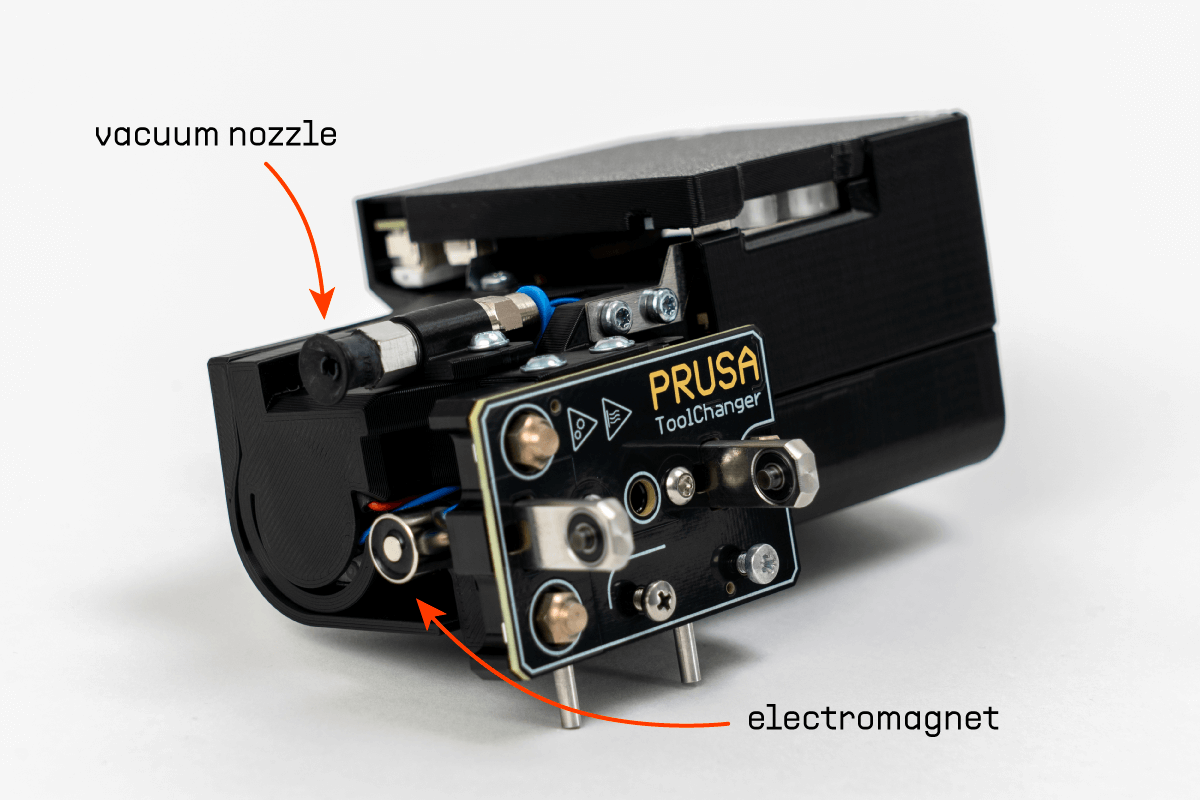
One Print, Multiple Components: Pick & Place Tool
Some technical prints require additional components, such as magnets, threaded inserts, or bearings, to be placed during the build. Without automation, this typically means you have to pause the print and insert the part(s) by hand. Although PrusaSlicer made this process easier a while ago, The Pick & Place toolhead can do it for you, completely autonomously. This reduces manual intervention and improves placement accuracy.
We’ve co-developed the toolhead with the Zurich University of Applied Sciences (ZHAW) and it’s designed for models that combine 3D-printed models with off-the-shelf components. We’re currently targeting late 2026 with its implementation.
The Proper Extruder
Since the first printer left our basement office in a pizza box, we’ve encouraged users to modify and rebuild their machines. Jón Shone from Proper Printing took this idea to the extreme. In his project often referred to as “F**k around the XL,” he replaced all five XL toolheads with his own belt-driven Proper Extruders. This setup is especially well suited for extremely soft materials, such as TPU 60A. You’d hardly find a better example of how flexible the XL platform truly is. You can replace one, two, or even all its default toolheads and it still delivers flawless results! Watch Jón’s tinkering journey below.
Big Price Drop
Alongside the printer itself, we’ve also refined XL production. These improvements allow us to manufacture the printer more efficiently, which in turn lets us offer it at a lower price. For example, the Assembled 5-Toolhead XL is now roughly $200 cheaper. The exact price depends on your region and currency, so please check the product page for current details. Please also note that by the end of 2025, we stopped producing the Semi-Assembled version, as announced in our Black Friday article.
XL’s Hidden Gems
There’re some XL features that we don’t talk about all that much, but they can be a real game-changer for your workflow. They might not look flashy on a spec sheet, but they make a real difference once you start relying on the printer day to day. Here are a few XL details that tend to matter more the longer you use the printer.
No waste whatsoever
Not only does the XL not “poop” heaps of scrap plastic, it needs no prime tower at all. You only need properly dried filament. With that loaded, you can print flawless prints with zero waste. Just take a look at this Skoda car our colleague printed with precisely 0g waste. We only tossed out the supports.

Huge volume
On a spec sheet, the XL’s 360×360×360 mm print volume looks like just a higher number. Wait until you actually put it to use! It really shines through once you start printing something huge like this giant Bulbasaur we built. That extra build volume saves you hours of part modelling, cutting, gluing, and sanding. To this day, there’s no other printer that gives you this much room for creativity with a toolchanger at your disposal.
Still the fastest
Even 4 years after its release, the XL is still the fastest way to mix five colors/materials in one print. This proves how timeless the design is. The best bit is that the quality remains perfect even on days-long prints.
Segmented heatbed
The XL uses a modular, segmented heatbed with 16 individually controlled tiles for uniform heating and higher reliability and energetic efficiency. This design reduces heat-related deformation common with large single-piece beds and improves print consistency across the entire surface.
Multiple nozzles
By swapping the default nozzles on some of your XL toolheads, you get several machines in one. A 0.4 mm high-flow nozzle works great for efficient PLA and PETG printing, a standard 0.4 mm is ideal for TPU, 0.25 mm nails miniature models, a 0.8 mm nozzle speeds up prototyping, and a hardened nozzle handles abrasives like PCCF.
Material Management
The five material slots make filament management straightforward. In practice, the first two spoolholders are often taken up by 1 or 2kg PLA and PETG spools; a go-to combo for everyday prints and supports. The third slot is perfect for TPU, whether you’re printing flexible parts or adding a bit of “rubberizing” to a design. The two remaining slots can hold tougher materials like PETG-CF and ASA, or whatever filaments you use most. From there, you simply pick the toolhead your project needs and start printing.

So that’s the XL in 2026! As you can see, it’s still going strong. It keeps on creating unique, complex models, print plate after print plate. We’ll make the best out of its flexibility as a time-proven multi-material platform using the new toolheads. These will open its skillset even wider. If you’re looking for a large machine that can handle any demanding project you throw its way and is ready to grow the XL has your back.
Happy printing!
Great to hear about the efficiencies in production that have allowed you lower the costs of the 5 head XL by ~$200.
Would be good for your existing customers if that could be reflected in the tool head upgrades, which as far as I can see have remained the same since the launch of the XL.
You haven't even included those tool head upgrades in your black Friday sales.
I second this, would upgrade my single head XL if the price would be lower but for now, it costs way more then a new gen. multicolor printer.
Same here – I Have dual head and would love to upgrade but i can't justify it when it's litterally more expensive than an assembled Core one. Please offer a discount on the upgrade – It would be great if there was an upgrade package with the pick & place tool so we don't need to pay for the extra nextruder we wouldn't use.
Really cool to read about the comparison between the XL and the indx system. Is there an estimate for the silicone printheads? And will there be different colored filaments for this?
I have a first day order XL and im fairly content… not entirely happy but content. I applaud the move forward and the adoption of INDX. I consider it , to the limit of my knowledge and opinion , a good choice. And thanks for the effort to justify the relevancy of the XL but… lets be honest here. Most of the MAIN sales points of the XL, like almost zero waste, multiple material and relatively high speeds will be present to the INDX also. I dont know how slower the INDX will be in the tool change factor but overall since the toolhead is substantially lighter, than that of the XL, then i guess you can achieve higher printing speeds, so the overall performance remains to be seen. I really dont mind the XL to be the last years model but i do mind … as a rather long time customer (mk3s, mmu2s, sl1 to sls, XL), the fact you didnt address some issues with something like an improvement kit. Cooling issues on mainboard and hotbed controller. You dont sell printer only on cold climates. This issues are resolved , somehow, with mods from the community. But a 4k printer is not supposed to rely on those. Is it so expensive to add a fan cooled cover? Is it so difficult to cool the heatbed module controller underneath? And after so many years the one think you present is a silicon and a magnetic head? And for a cost higher of a brand new MULTIMATERIAL printer of another company? I sound a bit negative but the fact is that i get the feeling that you dont put an effort to the XL proportionate to its price tag. What did we actually got since its release? An overpriced box/enclosure without proper thermal sensors and heat control. Let hope that you ACTUALLY plan some improvements on the XL on par to its original price tag. And i hope that the INDX goes well.
+1
+2
I hope the XL Pick & Place toolhead will be able to be used with two-toolhead and one-toolhead XL machines, or have a way of implementing them without buying nextruder toolheads (and then not using them). I have a two head XL and and very interested in the Pick & Place toolhead but cannot justify upgrading to a five head just to use it
(As I don’t want to give up having two printing toolheads for obvious reasons)
2026 and still no dynamic flow calibration, no resonance frequency calibration, no crash / lost step detection, and completely impractical TPU idle temp presets. Yes, you’re still going strong on being weak on the software side. Introducing new hardware that will delay quality-of-life features others had in back since 2024 will make you even stronger on being the weakest software/firmware provider on the market. After my XL, 3x C1, 3x MK4s, and one mini, I think I’ll look elsewhere in 2026. 👋
Enhancements I would like to see:
May 11/2025
XL: The ability to add the MMU3 to toolhead #5, for those days when 5 colors are just not enough 🙂
Prusaslicer: Bracketing the WipeTower in the Gcode (I can almost see how to do this with a post processing script) so that it is a cancelable object. For those days when it’s the @#@! WipeTower that fell over, but the model would probably finish ok without it.
XL: The ability to “tune” a print to add a filament join. For those days when you thought you had enough filament but now 15 hours later you see the end of the spool and you would just like to be able to go to bed and have it switch to that other spool
THIS ONE IS DONE XL: The ability to “tune” a print and load filament onto an extruder you weren’t useing, or is not currently printing now (see above) – yes it will pause the current print and have to swap toolheads twice…. DONE !!!
XL: The ability to have different heat bed tiles at different temperatures. For those times your printing a dummy13 and want the PETG joints over here and the PLA armor over there – ok this is a silly ask
DONE XL: Ability to assign fillaments and do spooljoin from the slicer (ok you can now do it from prusaconnect)
1/2026
Prusaslicer: Ability to swap around colors
TRICK for XL: change printers definition to have additional fake tools. Then you can use the flood paint feature to swap the colors around…
XL: Better part cooling
XL: Strobe based belt tuneing
XL: Printbed Heatbed Soaking should be able to be optionally done during change fillament all tools
2/2026
XL: When doing change-fillament-in-all-tools the ‘retracting fillament phase’ (new) should be done after the toolhead has been put back into the dock – there is no reason (that I know of) the printer cant move on to the next task while it is dont that
If you are serious about supporting the XL and not just leaving us all consider my above comment. Where is the famous PRUSA upgrade path?
For example how about better side fillament sensors, just take the one out of printables and support it, merged with the core one+'s improvements (where is my switch for flexables).
I wanted to add something to my previous post. You advertise the silicon and placement toolheads. That not something Prusa developed. Prusa, as company what addon did it offer for the XL? How YOU as Prusa kept it relevant?
I have a 2 toolhead XL with a home built enclosure.
The things I would like to have are as follows.
If the INDX extruder can be combined as a XL toolhead to lower the cost of an upgrade of all out 5 head XL upgrade.
Bring the 350C nozzle to the XL and have an official nozzle wiper.
For the Slicer, a big quality of life for the prints with composites. Please have it so that you can change the tool for just the top layers, bottom layers, and the outermost perimeter. This would allow no post processing on composite to have them be abled to be handled with out skin irritation and micro-tears.
Will the INDX system support printing with multiple nozzle types (different diameter/materials) too?
Let actions speak louder than words!
Shortly after its announcement, I confidently invested in a 5-tool-XL. The driving force behind this significant investment for me, as a hobbyist, was that through my start with the MK3s I had previously experienced how a product literally got better month by month: There were regular firmware and slicer updates that brought about significant improvements. And alongside that, there were also affordable hardware upgrades time and again. So you simply couldn’t invest in the wrong product, simply because the product kept getting better even after purchase. I had that same expectation with the XL and factored in the positive experience of the MK3 when considering the price of the XL: I didn’t want to buy the product as it was at the start, but rather invest in the product it would become over time.
Unfortunately, however – like so many others – I’ve had to conclude that the XL is heading toward becoming abandoned hardware even before it’s fully matured. While demonstrable improvements in hardware and software are lacking, I’ve accumulated more and more points of criticism, which have now led me to be very dissatisfied with my expensive Prusa printer and to no longer recommend that others buy Prusa printers.
Here are a few of the most serious issues:
– If you watch the announcement video from back then and compare the printer featured in it to a current XL-5T, you’ll notice: There’s a world of difference! Changing the nozzle doesn’t take seconds—it takes forever because of the necessary recalibration of all (!) nozzles! The simultaneous (!) use of different nozzle diameters in a single print was also unavailable for ages and is—as far as I recall—still in beta (or has that been quietly discontinued?). And I rather not tell you what I think about the official XL enclosure!
– The printer was initially shipped with 0.6mm nozzles, even though the printer apparently couldn’t handle them at all. That’s why it was later shipped with 0.4mm nozzles again. However, I had to pay for my set of 0.4mm nozzles out of my own pocket, just to be able to print as good parts as with the MK4…
– Nozzle cleaning regularly fails. For 20% of my XL prints, I have to run to the printer after the warm-up phase, clean the nozzle, and restart the print. That’s annoying. Whenever possible, I print everything on the MK4s. It has the same problem, but much less frequently. Where is the improved firmware or a decent cleaning mechanism, like the one apparently every budget printer has by now?
– One of the most recent firmware updates included a beta version that consistently caused many XL users (myself included) to have the print head slam into the dock at the wrong position or otherwise slam it roughly elsewhere. Although the problem was known, this firmware remained online for weeks until Prusa finally realized one day that the issue was important enough to be fixed. Apparently, Prusa doesn’t actually use the XL in real-world scenarios. It might be in use in a farm without tool changes, but not in the kinds of scenarios that regular customers face.
– When was the last hardware or software update? There are countless ideas for hardware improvements, but we’re waiting in vain for them on the XLs… And nothing is happening on the software front either…
This isn’t the Prusa experience I invested in back then, full of confidence and with such high expectations – boosted not only by the announcement video! I get that you’re trying to break away from the competition with the Core One and INDX. But what good is that if it means losing the community and the good reputation that helped you grow? As for me, I’m pretty much done with it…
Despite all the frustration, I still have a tiny glimmer of hope that the XL hasn’t been completely forgotten. After all, there’s this article here. But warm words don’t help frustrated XL users like me. Get back to work! Just like before. Bring improvements to the software! Test the XL yourselves in real-world use again! And finally release an affordable upgrade kit that proves the XL isn’t written off yet!
I still love my XL for larger prints but the claim that it is still the fastest way to print 5 materials is not going to stand up for long. Yes, my Snapmaker U1 only does 4 colours and the bed isn't as big but on comparable single or 4 colour prints it pretty much halves the print times of the XL with the same quality output and the same zero waste. It also takes about 15 seconds to start a print. About 2 mins with bed probing. The Xl can take 10 to 15 mins to start with probing. I couldn't believe how slowly it probed compared to my MK3s. It won't be long until a similar 5 head printer is out from another manufacturer. . I've had Prusa printers for years since the MK2. Had 2 of those. 8 MK3s's. 2 minis and an XL but it would be very hard to justify buying another XL unless it was for a very specific use case. If it was a bit faster and started up a bit faster it would make all the difference. If it is to carry on as a relevant printer for the next few years that is what needs to be worked on for the upgrade path in my opinion.